Procedures
Consent risks, operative steps, post-op orders, ward round checklists.

The urology reference I wanted in my pocket at 2am.
* Combined App Store and Google Play download total as of August 2026. Downloads do not represent verified unique users, active users or trainee status. The core reference works offline; leaflet downloads and Ariadne need a connection.
Consent risks, operative steps, post-op orders, ward round checklists.
Haematuria, retention, torsion, priapism, penile fracture, paraphimosis, catheter trouble.
Doses, antibiotic protocols, renal adjustment, interaction flags.
IDENTIFY, MIMIC, TWIST, eGFR, CPG, prostate volume.
Presentation frameworks, investigation pathways, referral guidance.
31 leaflets, handed over by QR code at the bedside.
A reference aid for clinicians in training. It does not replace local guidelines, senior review or your own judgement.
Six of them so far. Each one started as something that took too long.
Smarter on-call. Better decisions.
Pathways, procedures, doses and calculators in one place. The core works with no signal.
 On call · 02:00
From MRI to 3D understanding.
A public-research-data teaching prototype that connects MRI slices, sector anatomy, mental rotation and browser-based 3D exploration.
Teaching only. Not for diagnosis, PI-RADS assignment, biopsy planning or navigation.
Visit prostateview.com ↗See every calyx. Plan every step.
A de-identified, CT-derived teaching prototype for talking through collecting-system orientation, with a simulated scope route and calyceal search.
Not for diagnosis, treatment selection, patient-specific surgical planning or intra-operative guidance.
Visit calyxview.com ↗Learn the operation, not just the steps.
A browser-based operative and complications atlas using stylised 3D scenes, danger zones and active recall, built for rehearsal before a viva or a supervised procedure.
Schematic anatomy for teaching only. Review status varies by item and remains visible in the project.
Visit uroops3d.com ↗
Recognise the view. Rehearse the scope.
Browser-based exercises for spatial bladder and cystoscopy practice, using schematic teaching meshes rather than patient imaging.
No patient imaging or data. Simplified teaching pathways do not replace current guidance or local policy.
Open Cystosight ↗A thread through the pathway.
A retrieval-augmented assistant built into UroRef. Each query is routed through a Cloudflare Worker and combined with curated UroRef guidance, recent chat context and the selected hospital profile when available. Common requests are handled directly by the service; others use Google Gemini to return source-linked educational navigation, with pseudonymous rate limiting and explicit safety boundaries.
Service tools, built for the team that uses them.
Recovery, gently tracked.
Structured patient-reported outcomes for consultant follow-up after feminising genital gender-affirming surgery. Patients complete calm, skippable check-ins on their own device against a non-identifying reference code, from a pre-operative baseline to 24 months; the clinician sees explainable flags, change over time and a summary that is never a diagnosis. No names, NHS numbers or dates of birth are collected.
Not a medical device. It does not replace clinical review.
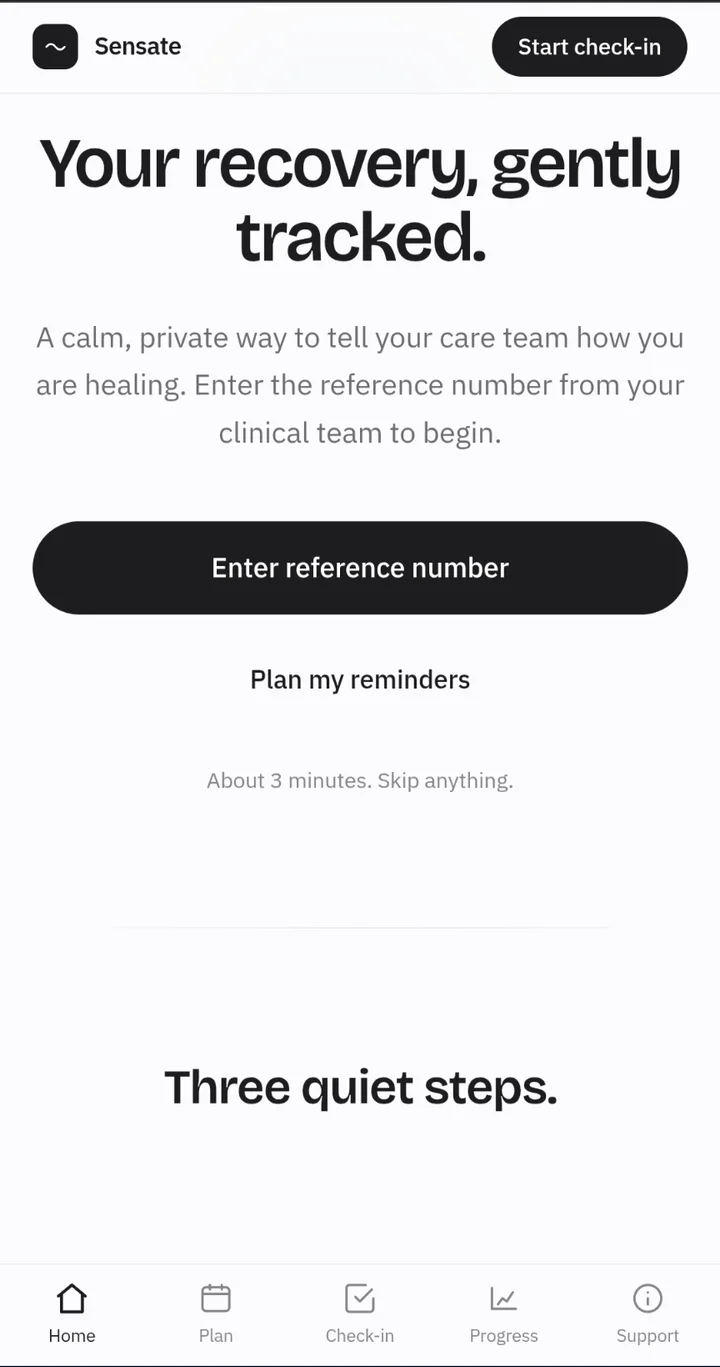 Patient app · demonstration build
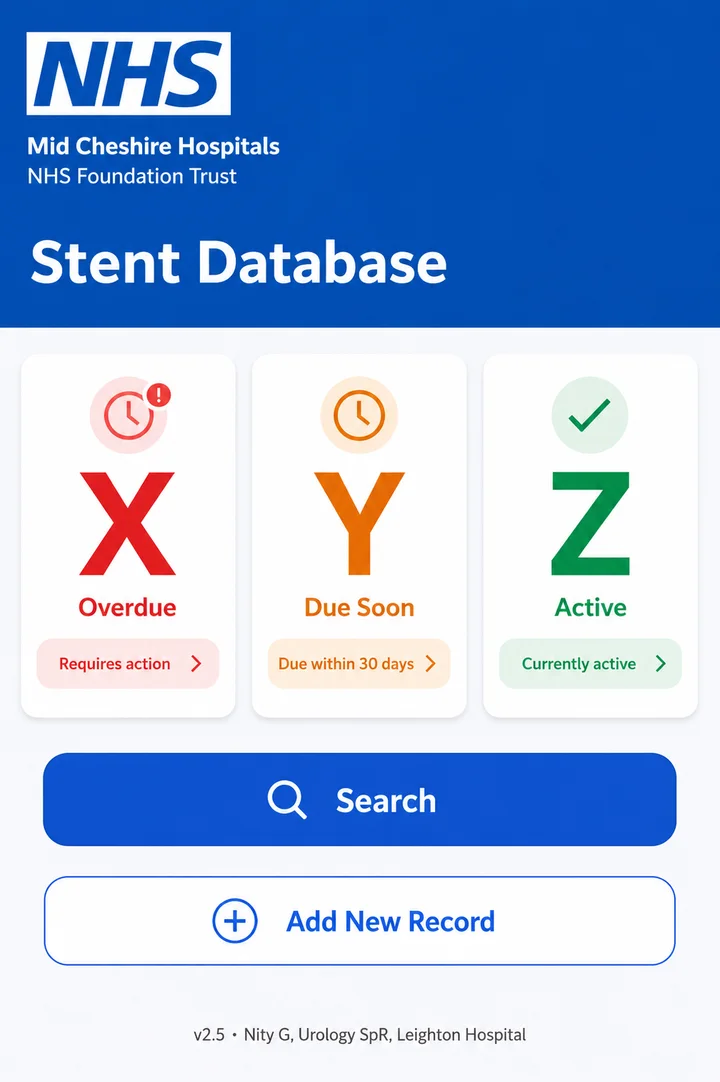 Home screen · demonstration view
No stent forgotten.
A register built in-house that closes the loop on ureteric stent tracking at Mid Cheshire Hospitals NHS Foundation Trust. Insertions are logged at the point of care, every stent is held against its intended exchange date, automated alerts flag what is coming due, and completed exchanges are archived with an audit trail. In service since April 2026.
One coded case, start to finish.
A data-collection tool for the EchoLaser service evaluation at the Royal Liverpool University Hospital. A separate coding step issues a random study code, so the clinical app never holds a name or NHS number. Each coded case then runs through baseline, procedure and recovery, follow-up and safety events, with dropdowns for fixed choices, BMI worked out from height and weight, and the 0 to 10 pain card entered on a slider.
Tested end to end with synthetic cases only. Not yet approved for real patient data.
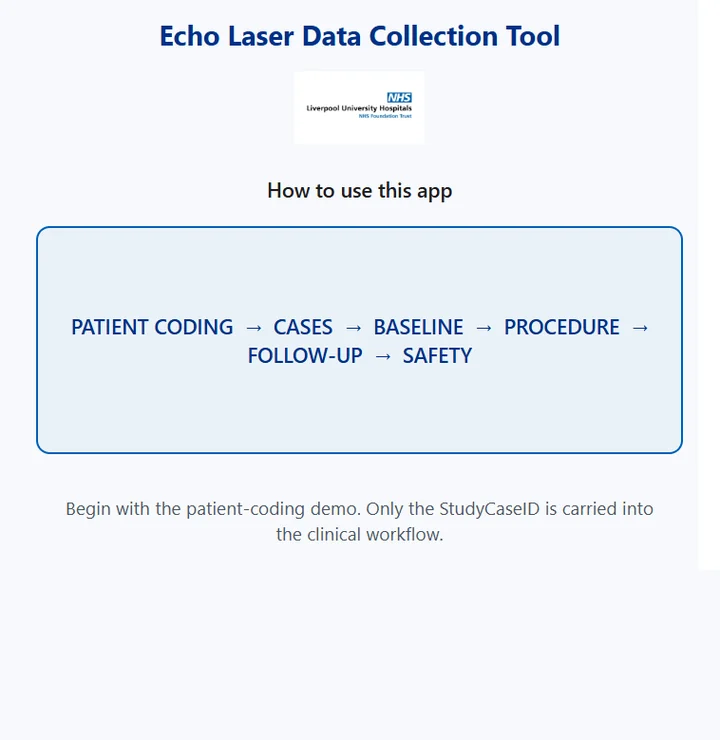 Clinical app · synthetic demonstration build
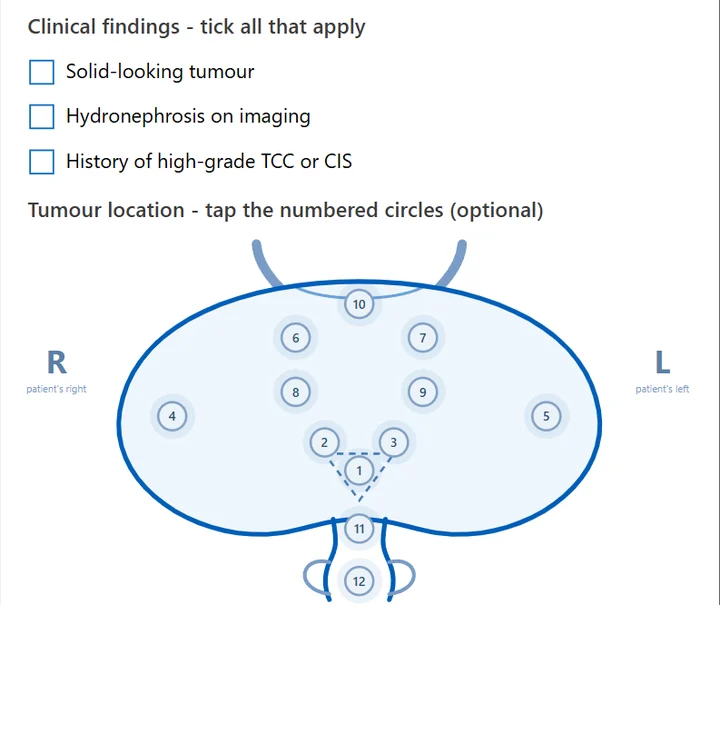 Tumour details · blank card, development build
Filled in at the scope, ready for the meeting.
A structured card completed straight after flexible cystoscopy, while the findings are fresh: lesion count and size, key findings, frailty, day-case suitability and a numbered bladder map for tumour site. Cards land in one shared list that becomes the worklist for the weekly Bladder Scheduling Meeting, where priority, consultant and theatre list are set, and the cancer trackers follow the same list through to TURBT. The dataset follows the June 2026 GIRFT guide to suspected bladder cancer.
Development build holding test data only, being set up with the team at University Hospitals of Liverpool Group.
The follow-up questionnaire, without the paper.
Electronic PROMs for follow-up after urethral stricture treatment, including Optilume. Patients scan one QR code, type a single-use code and answer on their own phone: a two-minute IPSS, quality-of-life and stream-picture check at 3 and 6 months, and the full questionnaire with USS-PROM, EQ-5D-3L and SHIM before treatment and at 12 months. Answers are checked and scored automatically, then set side by side on a clinician dashboard with amber flags and a summary line to copy into the clinic letter.
Working end to end with made-up patients. Needs a Trust-owned home, IG review and clinical-safety sign-off before any pilot.
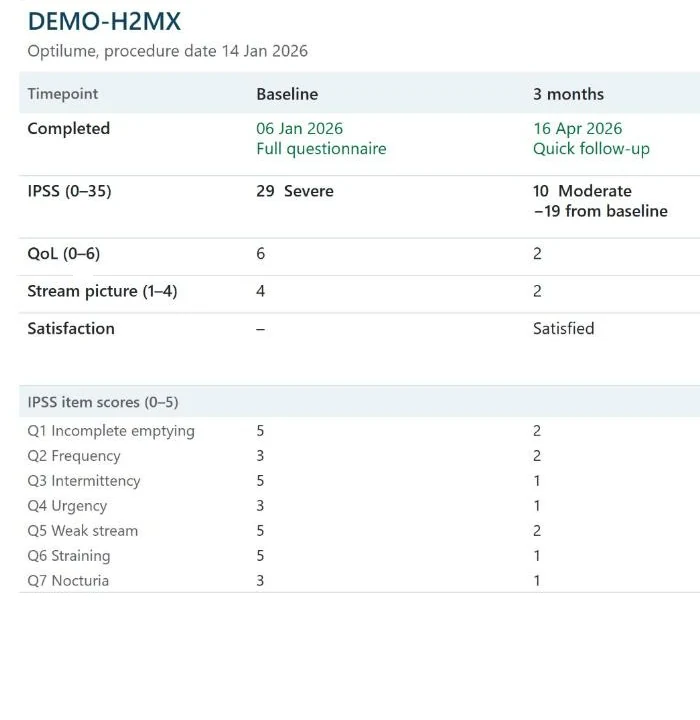 Clinician view · made-up patient

I built the thing I wanted in my pocket, then kept building.
Clinics, lists, nights, on-calls, and the hundreds of small decisions that sit between them. The tools came out of the gaps.
A quick route back into the latest UroRef deep dives.
Free · No account required for the core