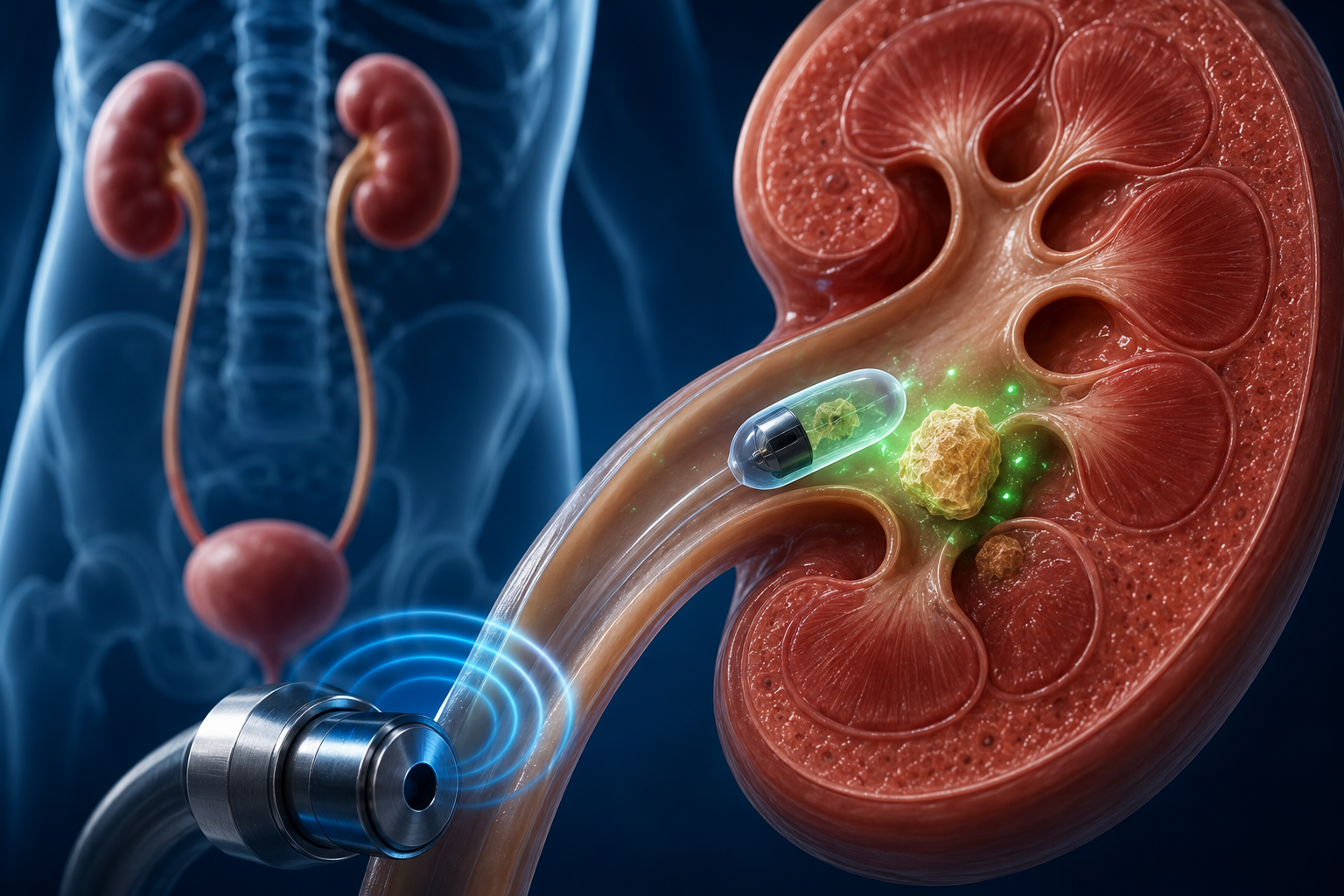
A team led by the University of Waterloo has engineered soft magnetic robots - about the size of a grain of rice - that carry the enzyme urease to a uric acid stone and dissolve it locally. Published in Advanced Healthcare Materials in 2025 and picked up by the wider science press this month, the work is entirely in vitro, but the concept is genuinely new.
Not a drug. Not a scope. Not shock waves. A tetherless magnetic device that delivers targeted enzymatic chemistry to a specific stone from millimetres away.
Why Uric Acid Stones Are the Right Starting Target
About 80% of stones are calcium oxalate. Uric acid stones account for roughly 5-10%. So why start there?
Because uric acid stones dissolve in alkaline urine. This is already how we treat them medically - potassium citrate to raise urine pH toward 6.5-7, then wait weeks or months for the stone to shrink. The problem is compliance, GI side effects, and the fact that systemic pH manipulation is inconsistent.
If you can raise the pH just around the stone, without altering the rest of the urine or the patient’s systemic biochemistry, you keep the mechanism that works and remove the reasons it fails. That’s what this device attempts.
Calcium stones don’t dissolve in alkaline urine - they need mechanical fragmentation or extraction. So this approach won’t touch the majority of stones we see. But it maps neatly onto a stone type where a slow medical dissolution already exists.
How the Robots Actually Work
The robots are hydrogel strips, roughly 1cm long and 1mm thick, made from gelatin methacryloyl (GelMA) - a biocompatible photocrosslinkable material. The hydrogel matrix holds urease throughout, and a small nickel-coated neodymium micromagnet (about 0.7 x 0.5mm) sits at one end for external control.
Two designs were tested. A fin-like configuration paddles through narrow spaces like the ureter using magnetic torque. A screw-like configuration rotates for stability in wider spaces like the renal pelvis.
Control is external: a motorised rotating permanent magnet on a robotic arm, operating at 2-16 Hz. Real-time tracking uses ultrasound in Doppler mode - the micromagnet shows up cleanly. No radiation, no tether, no scope.
Once at the stone, urease breaks down urea (naturally present in urine) into ammonia and CO2, raising the local pH from around 5.6-6.0 to 7.0-7.2. Uric acid becomes much more soluble at that pH, and the stone dissolves gradually while the robot stays in place.
The Data
Testing was done in synthetic urine using real uric acid stones (confirmed by FTIR spectroscopy). At the optimal urease loading of 5 mg/mL, robots produced an average 30% reduction in stone mass over 5 days, versus 15% in controls without robots.
The robots retained enzymatic activity for over 65 days with daily urine changes. Navigation was tested in a life-size 3D-printed urinary tract model derived from CT scans, with maximum speeds around 5 mm/s in a 4mm ureter. The hydrogel swells up to 200% in the first 24 hours but remains structurally intact for the intended treatment duration before gradual degradation.
What This Isn’t
This is a benchtop study using synthetic urine, 3D-printed anatomy, and static conditions. Real urinary tracts have peristalsis, variable flow, mucosal contact, and immune responses. None of that has been tested.
There are no live animal data. Long-term biocompatibility of the nickel-coated micromagnets, potential inflammation from the hydrogel, complete clearance after degradation, and behaviour in obstructed or infected systems all remain unknown.
Regulatory pathways - Health Canada, FDA, MHRA - require substantial preclinical and clinical data. Realistic time to human use is many years, assuming everything continues to work.
And the biggest limitation: uric acid stones only. The imaging characteristics that distinguish uric acid from calcium stones aren’t perfect. A patient would need dual-energy CT or prior stone analysis to be a candidate. In practice, uric acid stones that meet size and location criteria for this approach are a small fraction of a small fraction of the overall stone population.
Why It’s Worth Watching
Two reasons.
First, it’s genuinely novel. Every current uric acid stone strategy is systemic - you alkalinise the whole urine and hope. This delivers the chemistry to the stone directly. That’s a different design paradigm.
Second, the platform is potentially extendable. If the tetherless magnetic delivery of an enzyme to a specific intra-luminal target works, similar approaches could carry other therapeutic payloads - biofilm disruptors for infected stones or encrusted stents, targeted antibiotics, dissolution agents for cystine or struvite. The soft robot is the vector; the payload can change.
For now, it’s laboratory science with a plausible clinical target. Worth knowing about, not worth citing in consent. The next milestone that would matter is live animal work with real ureteric anatomy.
Magdanz V, Khabbazian A, Liu E, Kwong L, Yu A, Khamesee MB et al. Kidney Stone Dissolution By Tetherless, Enzyme-Loaded, Soft Magnetic Miniature Robots. Advanced Healthcare Materials, 2025. University of Waterloo. Reported by Fares Solution, July 2026.