Every urology on-call has this patient. Large prostate, frank haematuria, clot retention, three-way catheter in, irrigation running. Day one you wash. Day two you wash again and take him for a clot evacuation. Day three the urine clears, the irrigation comes down, and by the evening it’s rosé again. Somewhere around day four somebody says the word “embolisation” and somebody else says “he’s not fit for a TURP.”
Peterson, Krambeck and colleagues at a single high-volume US centre have published, in World Journal of Urology this month, what they did instead: take him to theatre and enucleate the whole gland, as an inpatient, on the index admission.
What They Actually Did
Retrospective review of every emergency HoLEP performed in the inpatient setting between January 2021 and August 2024. Twenty-four procedures in total, all for refractory haematuria, one of which also had a prostatic abscess.
“Emergency” here means what it sounds like: these were not men on a waiting list who happened to bleed. They were admitted, they failed conservative management - irrigation, clot evacuation, correction of coagulopathy - and the decision was made to definitively deobstruct rather than keep washing.
The Numbers
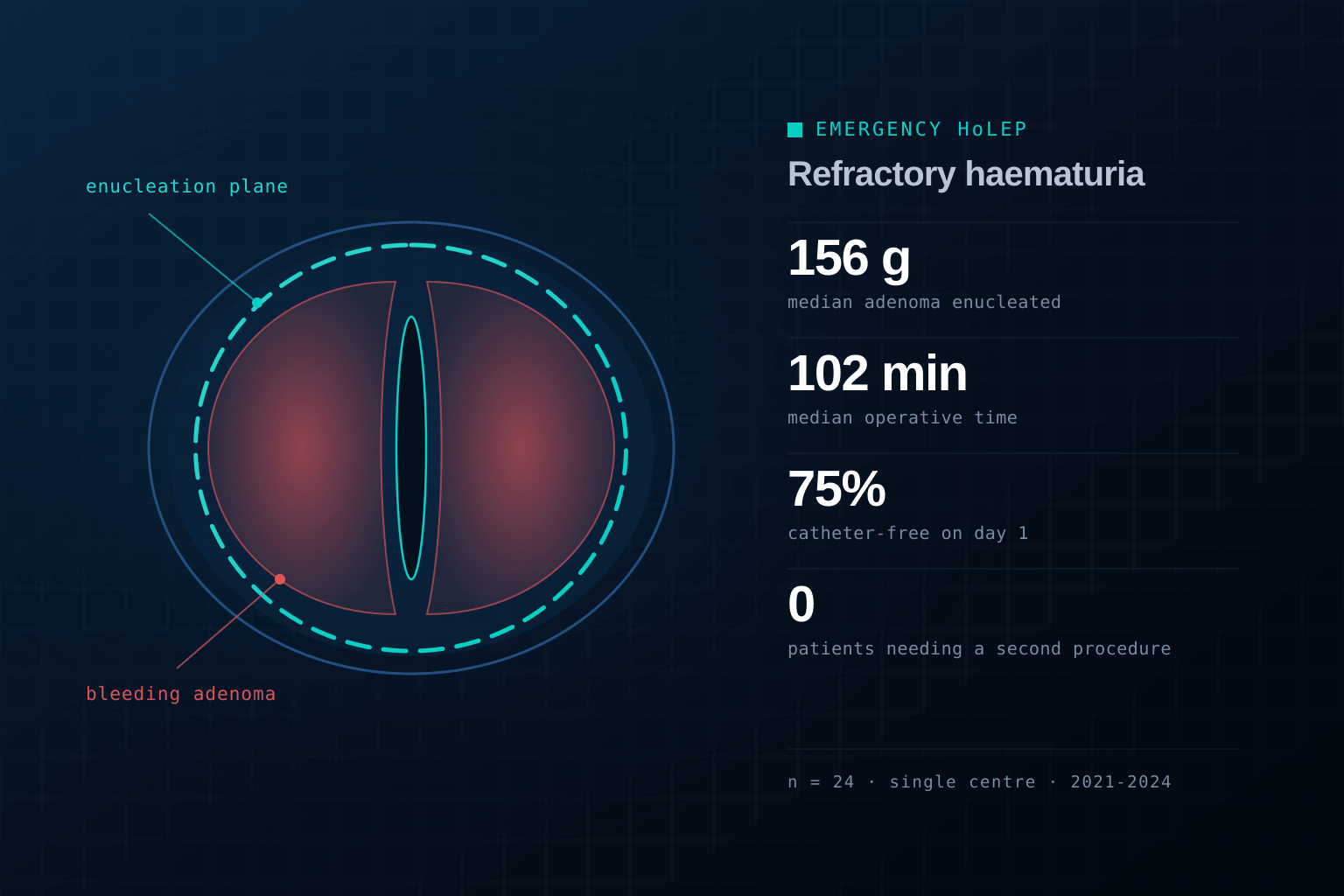
Median operative time was 102 minutes. Median enucleated prostate volume was 156g.
That second figure is the one to sit with. This is not a series of 40cc glands. These are large, vascular, adenomatous prostates - exactly the ones that bleed, and exactly the ones that a mid-table unit would be least keen to take to theatre acutely.
Ten patients required transfusion: eight pre-operatively and seven post-operatively (the counts overlap - some were transfused on both sides of the procedure). Given these were men already bleeding heavily enough to be admitted and fail conservative measures, a pre-operative transfusion rate around a third is a statement about how sick this cohort was on arrival, not a complication of the operation.
Eighteen of the 24 - 75% - passed their trial without catheter on post-operative day one. All were catheter-free at three months. No patient required an additional procedure.
That last point is the practical headline. Not “the bleeding settled.” Not “he went home with a catheter and we’ll see him in clinic.” The problem was solved once.
Why Enucleation Rather Than Another Washout
The reason prostatic haematuria recurs is that the bleeding surface is still there. Conservative management is a holding pattern: you clear the clot, you dilute the blood, you wait for the vessel to thrombose. Sometimes it does. When the gland is 150g and the patient is anticoagulated or has been on a 5-alpha reductase inhibitor for a fortnight with no effect yet, sometimes it doesn’t.
The alternatives when washing fails are all compromises:
- Channel TURP on an acutely bleeding large gland is a bloody operation with a high chance of leaving residual adenoma - which means leaving the bleeding surface behind.
- Prostatic artery embolisation works, but needs interventional radiology, a suitable vascular anatomy, and doesn’t address the obstruction. It is also not available out of hours in most UK units.
- Long-term catheter is a defeat that gets rebranded as a plan.
HoLEP removes the adenoma at the surgical capsule plane and coagulates as it goes. The bleeding surface is excised rather than resected around. That is the mechanistic argument. This series is one of the few attempts to test whether it holds up when the operation is done acutely rather than electively.
What This Doesn’t Tell Us
Quite a lot, and worth being honest about.
It’s retrospective, single-institution, 24 patients, no comparator arm. There is no group of men who continued conservative management or went for embolisation, so “safe and effective” here means “nothing terrible happened in 24 selected cases,” not “better than the alternative.”
The surgeon factor is doing heavy lifting. Amy Krambeck is one of the highest-volume HoLEP surgeons in the world. A 156g gland enucleated in 102 minutes in the middle of an acute bleed is a very different proposition in the hands of someone who has done a thousand of them. The result is a demonstration of what is possible at a centre of excellence, not a protocol you can lift into a district general on a Saturday night.
“Refractory” is also not defined in a way that transfers. How many days of irrigation, how many washouts, how many units? Without that threshold, the decision point stays a matter of judgement.
And there is no data here on the men who weren’t offered it. Twenty-four emergency HoLEPs over three and a half years at a centre that size implies selection - the frailest, the most unstable, the ones with prostate cancer rather than BPH as the bleeding source, probably went down other routes.
What It Changes for the On-Call Registrar
Not your practice tomorrow, but your framing.
The default mental model for refractory prostatic haematuria is escalation through increasingly desperate holding measures, with definitive surgery deferred until the patient is “stable” - which for a man who is bleeding from an obstructing 150g prostate can mean never. This series inverts that: the definitive operation is the way to stabilise him, and delaying it is what accrues the transfusions, the bed days, and the second and third anaesthetics.
The practical UK question is access. Enucleation on an acute list requires an enucleation surgeon, a laser, a morcellator, and a theatre slot - and in most units at least two of those four are unavailable at 9pm on a bank holiday. But it reframes the conversation with the consultant on call from “can we hold him until Monday” to “who on this rota enucleates, and can we get him on their list this week?”
If the answer is nobody, that is a service issue worth naming rather than a clinical inevitability worth accepting.
Peterson JT, Guo J, Patel A, Helon J, McDonald A, Fadl-Alla A, Xu P, Krambeck AE. Emergency holmium laser enucleation of the prostate for management of refractory hematuria. World Journal of Urology 2026;44(1):582. PMID 42611086. Summarised on UroToday, August 2026. The approach was first described in World Journal of Urology in 2023 as a single-institution series.