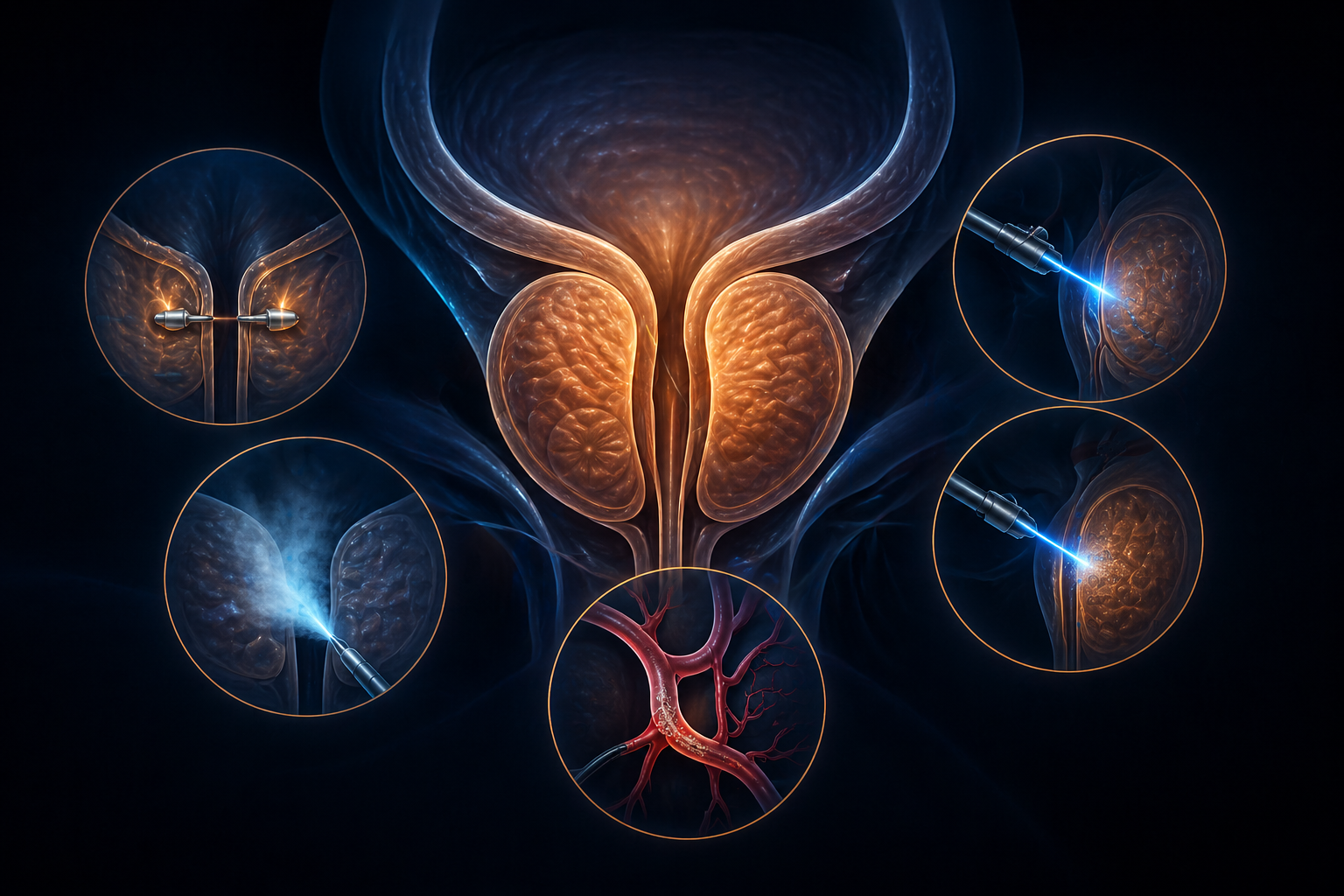
I’ve sat in enough BPH grand rounds to notice the pattern. A new device appears. The slides show a clean anatomical illustration, an early trial curve, and an ejaculatory preservation rate. The language is always somewhere between “promising” and “practice-changing.” And then, usually, it quietly disappears from the next year’s slides.
The second wave of LIST and FIT devices - Optilume, Zenflow Spring, Butterfly, ProVee, Urocross, FloStent - is a more serious attempt than most. They’re addressing a real gap, and some of them have more substance behind them than previous iterations. But as a trainee, the question isn’t whether they’re interesting. It’s whether you can tell the difference between a genuine step forward and a better-packaged version of the same trade-off.
The Real Clinical Gap
The problem these devices are trying to solve is legitimate. A lot of men sit awkwardly between medication that’s no longer adequate and an operation they don’t feel ready for. UroLift, Rezum, and iTind have helped fill that space, but none of them suit every prostate, and the anatomy constraints are real.
The second-wave pitch is: better anatomical tailoring, lower treatment burden, and stronger preservation of function. That’s a meaningful offer if it holds up.
What Gets Oversold First
Ejaculatory preservation is the commercial lead for most of these devices, and it’s a clinically real outcome - men care about it and it’s historically been underweighted.
But it’s also the easiest endpoint to make look good. Select the right patients, exclude the ones with complex anatomy, report at six months, and preservation rates look excellent. What that doesn’t tell you is whether the device deobstructs adequately, how it performs in a prostate with a prominent median lobe, or what the retreatment rate looks like at two years.
When sexual preservation is the headline, look carefully at what isn’t in the abstract.
The Questions Worth Asking
This is what actually helps in clinic or a tutorial when a new device comes up. Rather than trying to memorise early trial data that may look different in two years, it’s more useful to ask:
- What anatomy is it actually for? Prostate volume range, median lobe, bladder neck configuration - the good devices have a specific answer.
- Does it deobstruct, or does it mainly remodel? That distinction matters for long-term outcomes.
- What’s the retreatment burden at two years or more? One-year data is not enough.
- What does it add over the first-wave LISTs? Over UroLift or Rezum specifically, not just over TURP.
- For a man who’s a surgical candidate - why not HoLEP or Aquablation? If there’s no good answer, the indication is narrow.
A device that can’t answer questions three, four, and five clearly is interesting, not proven.
Where Optilume Is Different
Optilume gets more serious attention than the others at the moment. It has a clearer device identity - mechanical dilation plus paclitaxel drug delivery, a more developed dataset, and a more specific clinical rationale. It’s the most mature of the current wave.
But “more mature than the others” and “ready for routine practice” are different claims. The honest position is interest with scrutiny. The questions above still apply.
The Honest Bottom Line
The gap these devices are targeting is real, and some of them represent genuine thinking about how to improve the efficacy-function-burden balance rather than just rebranding it.
But the correct default when a new device appears isn’t enthusiasm. It’s appraisal. Anatomy fit, deobstruction, retreatment burden, comparison against what already exists.
The language will keep shifting. “Promising” is fine as long as it comes with the next question.
Gómez Sancha F. The Next Wave of LISTs for BPH: How Much Is Innovation, How Much Is Hype? April 2026. drgomezsancha2.blogspot.com