I’ve said something like that more times than I can count. It’s the default. Easy to give, easy for patients to understand. And it’s not wrong - increased fluid intake is associated with reduced stone recurrence in the observational data.
But a well-run RCT published in the Lancet in March 2026 has just made that advice considerably more complicated.
What the PUSH Trial Found
The PUSH trial followed 1,658 symptomatic stone patients over two years. Participants randomised to the hydration intervention successfully increased their urine output. Volumes went up. The surrogate endpoint was achieved.
Stone recurrence didn’t budge.
The primary outcome showed a hazard ratio of 0.96 (95% CI 0.77 to 1.20). Essentially no effect. Increasing urine volume, through a well-designed and well-supported intervention, didn’t meaningfully reduce recurrence in this general cohort.
Why It Matters
PUSH separates two things the literature had blurred: urine volume as a surrogate, and actual stone events as the clinical outcome. For years the logic was: more water, more dilute urine, lower supersaturation, fewer stones. Physiologically sensible. Observational data agreed. But does achieving higher urine output in real patients actually change outcomes?
In a general stone-forming cohort: not reliably.
The Shift in Practice
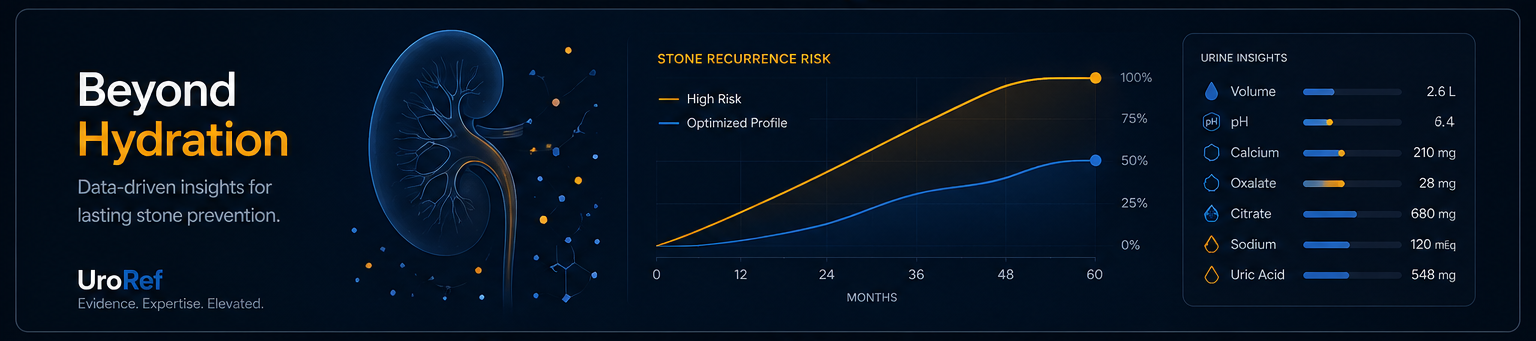
This doesn’t mean abandoning hydration advice. Low urine volume remains a modifiable risk factor. But PUSH tells us hydration alone isn’t enough for an unselected stone-forming population.
For any patient with recurrent stone disease, the question now is what’s driving the formation metabolically, not just how much they’re drinking. That means:
- 24-hour urine profiling - calcium, oxalate, citrate, uric acid, volume, pH
- Stone composition analysis if a stone’s been retrieved
- Serum calcium to exclude primary hyperparathyroidism
- Targeted advice based on the actual metabolic abnormality
The water advice still goes in. It just can’t be the whole plan anymore.