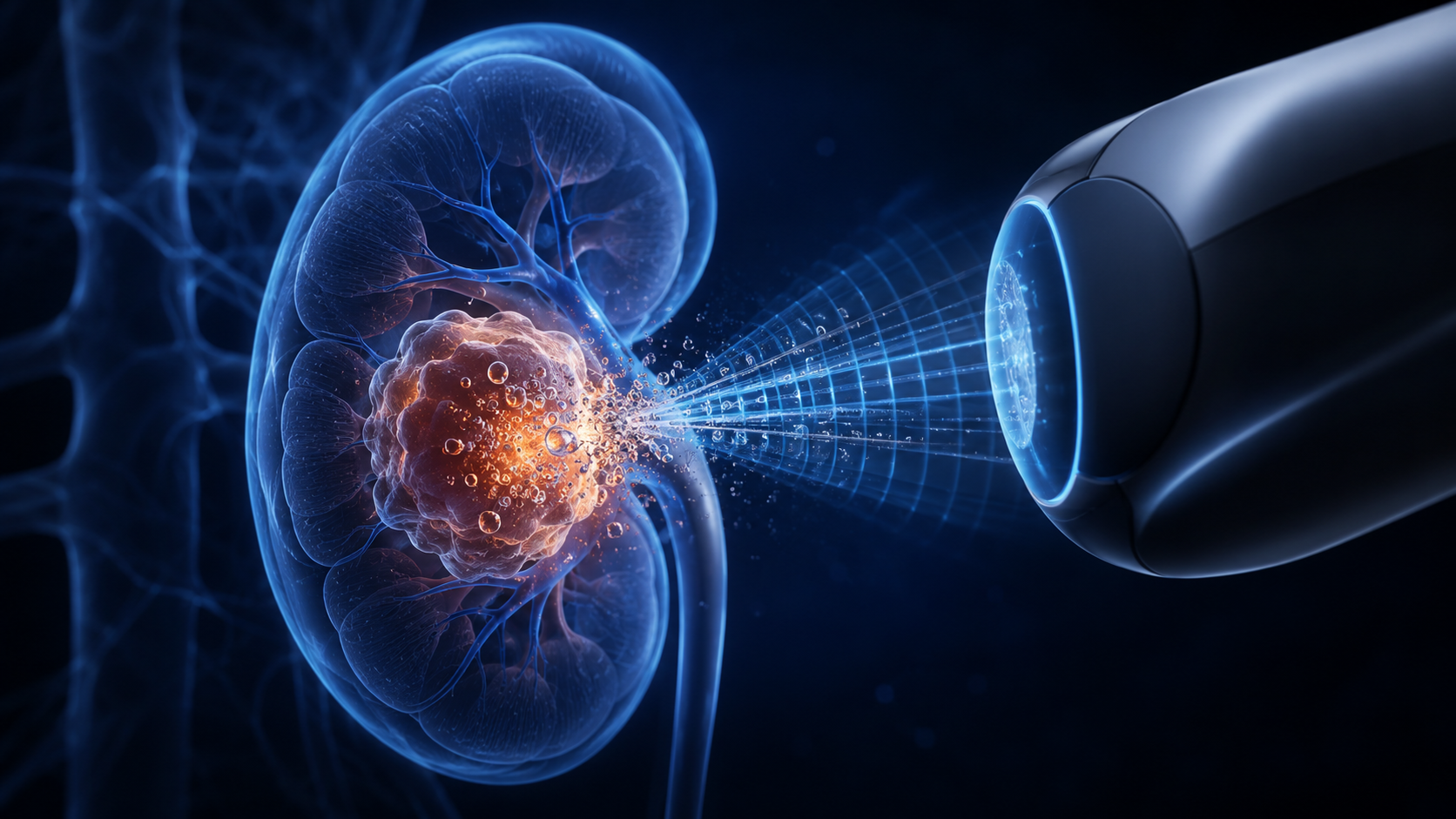
HistoSonics submitted a De Novo request to the FDA on 11 May 2026 seeking authorisation to use their Edison Histotripsy System for the destruction of kidney tumours. The system is already FDA-cleared for non-invasive destruction of liver tumours (since October 2023). If authorised for renal masses, this would be a genuinely new category of treatment in uro-oncology.
Histotripsy wasn’t on my radar until this week. Now it keeps coming up. Worth understanding what it actually is and what it isn’t.
What Histotripsy Does
The word comes from the Greek: histo (soft tissue) and tripsy (breakdown). It’s a focused ultrasound technology, but it’s fundamentally different from HIFU. HIFU uses heat. Histotripsy uses mechanical cavitation.
The Edison system delivers microsecond ultrasound pulses that generate controlled acoustic cavitation at a precise focal point. Nanometre-scale gas pockets in tissue act as cavitation nuclei. When negative pressure exceeds a threshold, those pockets rapidly expand and collapse, creating mechanical stresses that destroy cells at a sub-cellular level. The targeted tissue liquefies and is gradually resorbed over one to two months, leaving minimal scar tissue.
The key differences from existing ablation: non-invasive (no needles, no probes), non-thermal (no heat sink effect, no charring), non-ionising (no radiation), and done under continuous real-time ultrasound visualisation. The operator can watch the tissue being destroyed as it happens, which is something neither cryotherapy nor RFA offers in the same way.
The Liver Story So Far
The Edison system was first-in-human in 2018 (phase I, 11 patients with advanced multifocal liver tumours). FDA De Novo clearance came in October 2023 for non-invasive destruction of liver tumours, including unresectable ones. The HOPE4LIVER trial data presented in 2025 showed 90% local tumour control at 12 months. The system has since been adopted across US academic and community centres.
That liver trajectory matters because it’s the safety and feasibility record the kidney submission is building on.
The Kidney Submission
The FDA filing is supported by the HOPE4KIDNEY trial: prospective, multicentre, single-arm pivotal study, 67 patients, with William Huang at NYU Langone as principal investigator.
Beyond that, detail is limited. We don’t have published efficacy endpoints, follow-up duration, tumour size range, or complication rates yet. This is a regulatory submission, not a peer-reviewed publication. The clinical data will matter enormously when it arrives.
The rationale is straightforward. Around 80,000 new kidney tumour diagnoses are expected in the US in 2026. Current nephron-sparing options are partial nephrectomy (invasive, requires anaesthesia, surgical morbidity) and thermal ablation (percutaneous, still invasive, with bleeding and thermal injury risks). A genuinely non-invasive, non-thermal option that preserves renal function would fill a real gap, especially for poor surgical candidates or those with solitary kidneys.
What We Don’t Know Yet
Quite a lot, honestly.
Tumour size and location limits. Thermal ablation works best under 4 cm (T1a). We don’t know the size and anatomical constraints for histotripsy in the kidney. Central tumours near the hilum or collecting system may present different challenges from peripheral cortical masses.
Oncological outcomes. 90% local control at 12 months for liver is promising but short follow-up for oncology. Kidney tumours need at least 3 to 5 year recurrence and metastasis-free survival data before meaningful comparison to partial nephrectomy or cryoablation.
Renal anatomy challenges. The kidney moves with respiration, sits behind bowel and ribs, and has a highly vascular hilum. The real-time ultrasound visualisation helps, but acoustic windows matter.
Cost and access. The Edison system is capital-intensive. Even if cleared, adoption depends on reimbursement, case volume economics, and whether it can be delivered as a day case.
Why It’s Worth Watching
Even with those unknowns, three things make this worth following.
First, it’s a genuine new mechanism of action. Mechanical cavitation avoids the heat sink problem that limits thermal ablation near large vessels. That’s not a refinement - it’s a different approach.
Second, the non-invasive, non-thermal profile could expand who’s treatable: patients on anticoagulation, solitary kidneys, those unfit for surgery or anaesthesia.
Third, HistoSonics is explicitly building a multi-organ platform. Liver done. Kidney in FDA review. Pancreas and prostate on the roadmap. If it works across solid organs, it changes the landscape of focal therapy across multiple specialties.
This is one to watch closely and appraise carefully when the data arrives. Not one to get excited about based on a press release.
HistoSonics Inc. press release, 11 May 2026. HOPE4KIDNEY trial (ClinicalTrials.gov). Edison system FDA De Novo clearance for liver tumours, October 2023. HOPE4LIVER 12-month data, BusinessWire, April 2025.