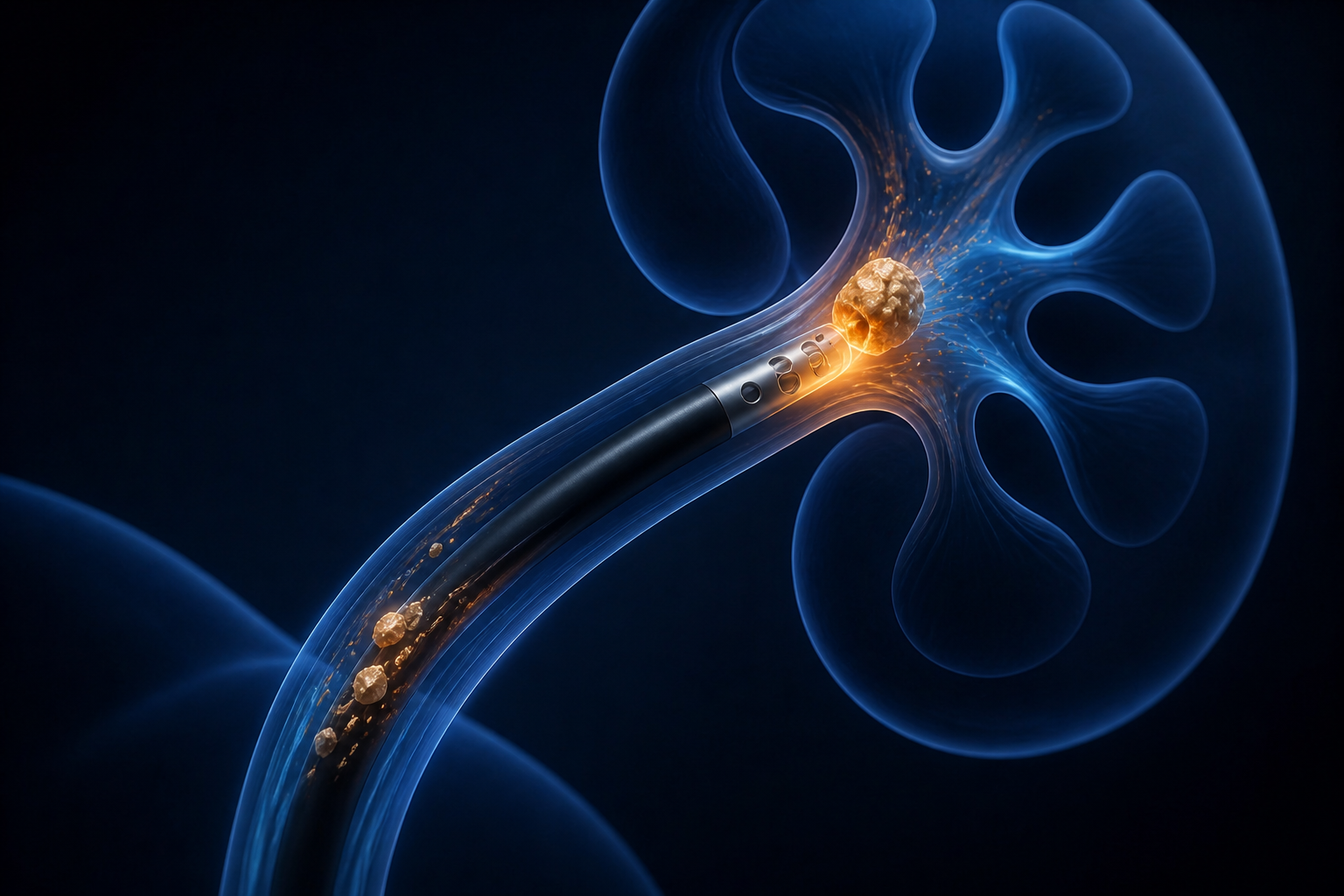
I hadn’t really thought about what happens to the dust after URS until I started looking at the data. We fragment, maybe basket the bigger pieces, and move on. On sensitive imaging though, 20 to 50% of patients have residual fragments after conventional flexible ureteroscopy. Those fragments aren’t harmless. They seed regrowth, drive ED attendances, and generate the stent placements and second-look procedures that quietly fill theatre lists.
The Calyxo CVAC system tries to fix that by building suction directly into the scope.
What It Is
A single-use 11.9 Fr digital flexible ureteroscope with two independent channels running at the same time: continuous irrigation in, vacuum aspiration out. You fragment and suck simultaneously. Fragments collect in a trap on the handle for composition analysis. No baskets needed.
The trade-off is calibre. It’s fatter than a standard fURS and needs a 12/14 Fr ureteral access sheath. Fine in most adult ureters, but a problem in tight or scarred ones. Which is a bit ironic, since those patients tend to have the worst residual fragment burden.
The Evidence That Matters
The ASPIRE trial is the one to know. Multicentre RCT, 11 US sites, 123 patients, renal stones 7 to 20 mm. Two things about the design stand out: residual stone volume was measured on 1.25 mm NCCT slices (far more sensitive than the usual 3 to 5 mm), and they tracked healthcare consumption events out to two years rather than just reporting a 30-day stone-free rate.
Results: roughly 97% mean stone clearance with CVAC, holding steady regardless of stone burden. Standard URS clearance dropped as stones got bigger. At two years, three healthcare events in the CVAC arm versus 20 in the standard arm. A 73% reduction.
That’s a meaningful difference. But it’s one industry-funded RCT with 123 patients. Independent replication is still thin.
DISS vs CVAC
Direct in-scope suction using a standard scope has been around for a while and works to a degree. But it repurposes the working channel for outflow, so you lose irrigation while you’re suctioning. CVAC runs dedicated channels independently.
In-vitro data from EAU 2025 showed CVAC cleared fragments better across stone sizes. Ex-vivo data showed standard URS produced up to 2.9-fold higher intrarenal pressures than CVAC in non-compliant ureters. That’s a safety argument as much as an efficacy one.
But there’s no randomised clinical comparison between the two yet. The margin of CVAC over a well-done DISS technique in real practice is genuinely unknown.
The Honest Bottom Line
The residual fragment problem after URS is real, underappreciated, and probably drives more downstream morbidity than most of us think about on the day. CVAC addresses it with a clean mechanism and the strongest evidence base of any new endourology platform at this stage.
But “strongest at this stage” is a relative bar. Single RCT, modest sample, industry-funded, no DISS comparator, no NHS cost-effectiveness data, and a scope calibre that limits access in difficult ureters.
Worth knowing about. Not yet worth reorganising a department around.
Matlaga BR, et al. ASPIRE: A Prospective, Randomised Trial of the SURE Procedure with the CVAC System vs Standard Ureteroscopy. J Endourol 2024. Two-year outcomes: CLEARANCE/ASPIRE long-term data, 2026.